New Book Excerpts #1: Spoon-winged Lacewings
My NEW BOOK is now out in the wild. Secure a copy, or, even better, get someone to buy it for you. Use it as place-mat. Use it as a doorstop. Use it to apprehend a miscreant. Use a number of them to reach a high shelf. You could even read it and marvel at these superb animals, sublimely illustrated by the talented Carim Nahaboo, all of which has been beautifully produced by Laurence King Publishers, part of the Orion Group.
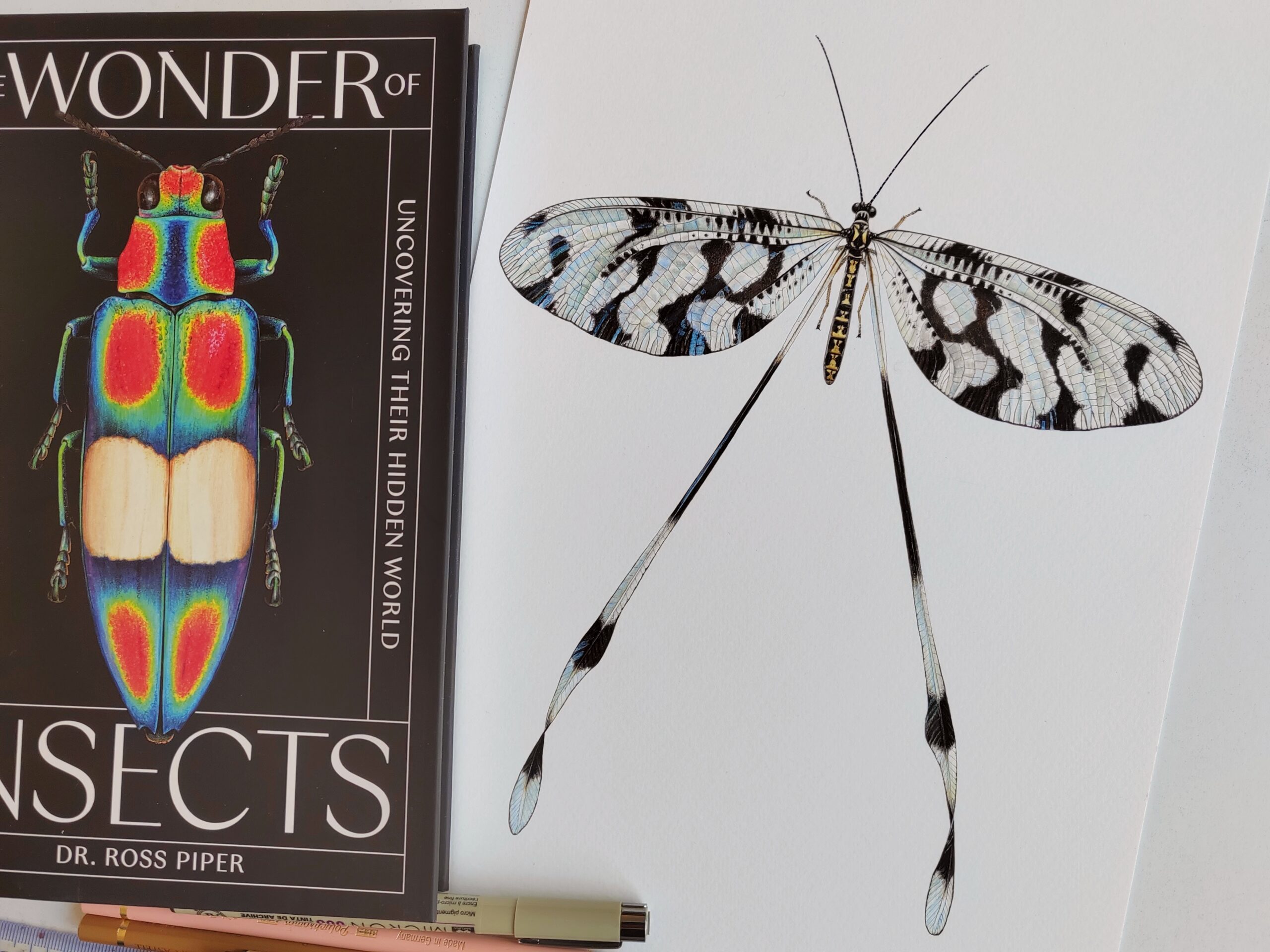
I’ll post a few excerpts from the book. First up is the Spoon-winged Lacewing:
“Up until fairly recently, international travel was the preserve of the well-to-do, the dispossessed or the military. Very nearly 200 years ago, a couple of characters from the former camp, French painter and naturalist Jean Louis Florent Polydore Roux and the Austrian diplomat, botanist and explorer Charles von Hügel, were travelling through Egypt en route to Bombay. Writing about his time in Egypt, Roux is distinctly unimpressed by the lack of insects, but when poking about in the rock tombs around the great pyramids of Giza, probably looking for booty, he spots something amid the sand that does get him going, describing it thus: “…I encountered a small animal, so extraordinary, so singularly-shaped…I take pleasure in sending you a drawing of it.” You can almost feel his excitement. He christened it Necrophylus arenarius, which translates as ‘corpse-lover of the sand’.
What Roux found and beautifully drew was indeed singular. It was the larva of a spoon-wing, which are among the most peculiar of all insect larvae. It looks like a guitar – the triangular head sporting a pair of sickle-like mandibles is attached to the soft, plump body via an impossibly long, thin neck. Adult spoon-wings are no less dramatic, what with their extremely long, often ornate hind wings and mouthparts drawn into a long rostrum, which they use to feed on pollen. They are insects of semi-arid and arid lands across a good swathe of the planet, although at least half of the known 150 species are only found in South Africa. Even though they’ve been fluttering around for the best part of 150 million years, they’re often scarce and the adults are rather short-lived…”

Leave a Reply